





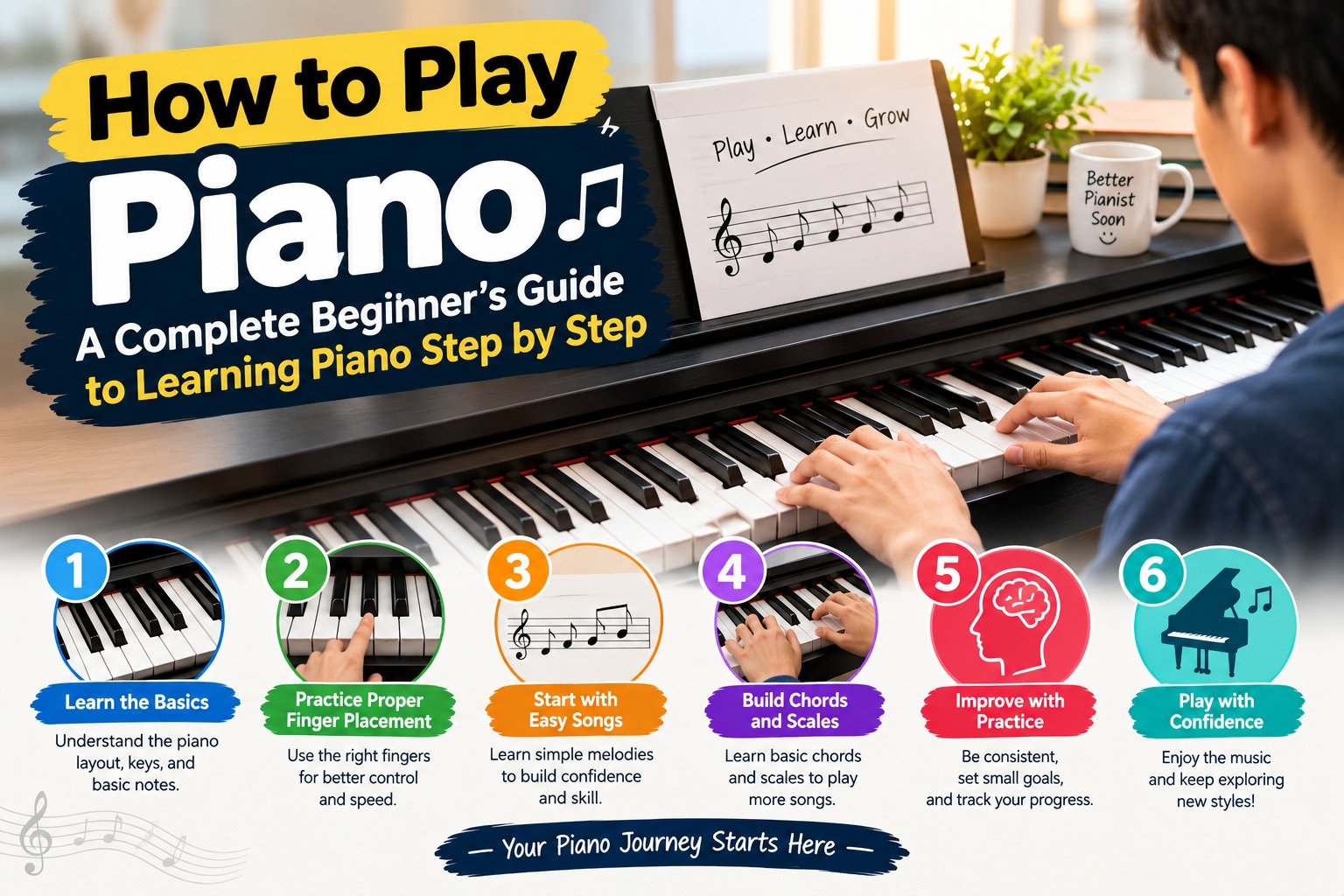
Learning how to play piano can be an exciting journey, whether you dream of playing your favorite songs, creating your own music, or simply enjoying a new hobby. Although the piano may look complicated at first, getting started is easier than many beginners expect. You do not need previous musical experience, perfect pitch, or expensive […]
Learning how to play piano can be an exciting journey, whether you dream of playing your favorite songs, creating your own music, or simply enjoying a new hobby. Although the piano may look complicated at first, getting started is easier than many beginners expect. You do not need previous musical experience, perfect pitch, or expensive equipment to begin. With a basic understanding of the keyboard, proper hand positioning, and regular practice, you can start playing simple melodies and gradually develop your skills. This guide explains how to play piano step by step, from identifying the keys and learning basic notes to playing chords, reading music, and building an effective practice routine.
What Do You Need to Start Playing Piano?
Before learning your first song, you need an instrument and a comfortable place to practice. Fortunately, beginners have several options.
Choose a Piano or Keyboard
You can start learning on an acoustic piano or an electronic keyboard. Both allow you to develop fundamental piano skills.
- Acoustic piano: Produces sound through hammers striking strings. It offers a traditional playing experience but requires more space and occasional tuning.
- Digital piano: Reproduces piano sounds electronically and often includes weighted keys, headphone connections, and volume controls.
- Electronic keyboard: Usually offers different instrument sounds, built-in rhythms, and portable designs. It can be a practical choice for beginners with limited space or budget.
If you plan to continue learning, consider a digital piano with 88 weighted keys. However, a smaller keyboard can also work for learning basic notes, melodies, and chords.
Prepare Your Practice Space
Choose a quiet location where you can sit comfortably and concentrate. Place your instrument on a stable stand or piano desk, and use a bench or chair that allows your arms to move freely.
You may also find these items helpful:
- A beginner piano method book or online lessons.
- A metronome for maintaining a steady rhythm.
- Headphones if you use a digital keyboard.
- A notebook to track practice goals and progress.
You do not need every accessory immediately. Start with what you have and add equipment as your skills develop.
Step 1: Learn the Piano Keyboard Layout
Understanding the keyboard is one of the first steps in learning how to play piano. A standard piano has 88 keys, including white and black keys, but the same pattern repeats across the instrument.
Understand White and Black Keys
The white keys represent the natural notes: A, B, C, D, E, F, and G. After G, the sequence begins again with A.
The black keys are arranged in groups of two and three. These groups provide a simple visual guide to finding notes.
To identify the notes:
- Find a group of two black keys.
- Look at the white key immediately to their left. This is C.
- Moving right from C, the next white keys are D and E.
- The three white keys around the group of three black keys are F, G, and A, followed by B.
- Repeat the pattern across the keyboard.
Once you recognize this arrangement, you can locate notes more confidently without counting every key.
Find Middle C
Middle C is an important reference point for beginner pianists. On a standard keyboard, it is the C near the center of the instrument.
Finding Middle C gives you a useful starting position for learning simple melodies and coordinating your hands.
Practice locating Middle C several times without looking at a diagram. Then find the C notes in higher and lower positions. This exercise helps you become familiar with the keyboard.
Step 2: Learn the Correct Hand Position
Good technique begins with a comfortable playing position. Poor posture and unnecessary tension can make practicing more difficult, so develop healthy habits from the beginning.
Sit Comfortably at the Piano
Sit near the center of the keyboard with your back naturally upright and your shoulders relaxed. Keep your feet supported and adjust the bench so your forearms are approximately level with the keys.
Avoid leaning too far forward or raising your shoulders while playing. Your arms should move naturally as you reach different notes.
Understand Piano Finger Numbers
Piano lessons and sheet music often use numbers to show which finger should play each note.
The numbering system is the same for both hands:
- 1: Thumb
- 2: Index finger
- 3: Middle finger
- 4: Ring finger
- 5: Little finger
Keep your fingers gently curved rather than completely flat. Press the keys with controlled movements and allow your wrists to remain flexible.
Practice Your First Five Notes
Place your right thumb on Middle C. Position the remaining fingers on the next four white keys.
Your fingers will be arranged as follows:
| Finger | Note |
| Thumb (1) | C |
| Index (2) | D |
| Middle (3) | E |
| Ring (4) | F |
| Little finger (5) | G |
Play the notes slowly from C to G, then return from G to C. Repeat the exercise several times without rushing.
Next, try the same five-note pattern with your left hand in a comfortable lower position. Focus on accuracy and relaxed movement instead of speed.
Step 3: Learn Basic Piano Notes and Music Reading
You can begin playing melodies without mastering music theory, but learning to recognize written notes will help you progress.
Understand the Musical Staff
Written piano music uses five horizontal lines and four spaces called a staff. Notes appear on these lines and spaces to indicate their pitches.
Piano music commonly uses two clefs:
- Treble clef: Generally used for higher notes and often played by the right hand.
- Bass clef: Generally used for lower notes and often played by the left hand.
Middle C sits just below the treble staff or just above the bass staff, depending on the notation.
Start by learning a few notes around Middle C. As you become more comfortable, expand your knowledge to cover additional notes.
Learn Basic Rhythm
Reading notes tells you which keys to play, while rhythm tells you when and for how long to play them.
Common note values include:
- Whole note: Commonly held for four beats in 4/4 time.
- Half note: Commonly held for two beats.
- Quarter note: Commonly held for one beat.
- Eighth note: Commonly held for half a beat.
These values depend on the time signature, but they provide a useful starting point.
Try counting aloud while playing a slow sequence of notes. Keeping a steady pulse will help you develop better timing.
Step 4: Practice Simple Piano Scales
A scale is a sequence of notes arranged in ascending or descending order. Scales help beginners understand musical patterns, develop finger coordination, and become more familiar with the keyboard.
Start With the C Major Scale
The C major scale uses only white keys:
C – D – E – F – G – A – B – C
Play each note slowly with your right hand, beginning with your thumb on C. When learning the complete scale fingering, your thumb passes underneath your hand after E so you can continue toward F, G, A, and B.
For the left hand, the fingering differs. Learn the correct movement gradually rather than forcing your fingers into an uncomfortable position.
Practice one hand at a time until you can play the notes smoothly. Then work on playing the scale with both hands.
Focus on Accuracy Before Speed
Beginners often try to play scales quickly because they want to improve faster. However, speed is not useful if the notes are uneven or incorrect.
Use a slow, comfortable tempo. Listen to every note and notice whether your fingers move smoothly between keys.
Once you can play accurately several times in a row, gradually increase the tempo.
Step 5: Learn Basic Piano Chords
Chords allow you to play several notes together and create harmony. Learning a few common chords can help you accompany songs and develop your musical understanding.
Start With Three Basic Chords
A major or minor triad usually contains three notes played together.
Here are three beginner-friendly chords:
| Chord | Notes |
| C major | C – E – G |
| F major | F – A – C |
| G major | G – B – D |
| A minor | A – C – E |
Place your fingers over the appropriate keys and press the notes together gently. Listen to the difference between major and minor chords.
Major chords often sound bright or settled, while minor chords often have a more reflective quality. These descriptions are subjective, but listening carefully helps you recognize their different characters.
Practice a Simple Chord Progression
Try playing the following sequence:
C major → G major → A minor → F major
Play each chord slowly and give yourself enough time to move your hand to the next position.
Repeat the progression until the changes feel comfortable. Later, you can experiment with playing the chords in different rhythms or using your left hand for lower notes.
This four-chord progression appears in many popular songs, although the exact arrangement and key can vary.
Step 6: Play Your First Simple Piano Song
Learning a complete melody gives you a clear goal and makes practice more enjoyable. Choose a beginner song with a small range of notes and a steady rhythm.
Songs such as simple nursery rhymes or beginner arrangements of familiar melodies are good starting points.
Break the Song Into Small Sections
Instead of trying to learn the entire song in one sitting, divide it into short sections.
- Listen to the melody before playing.
- Identify the notes in the first phrase.
- Practice that phrase slowly with your right hand.
- Repeat it until you can play it accurately.
- Move to the next phrase and learn it separately.
- Connect the sections once each part feels comfortable.
If the song includes left-hand accompaniment, learn that part separately before combining both hands.
Coordinate Both Hands Gradually
Playing two different parts simultaneously can feel challenging because each hand performs a different movement.
Start with a short passage. Practice the right hand alone, then the left hand alone. Once both parts are familiar, combine them at a slower tempo.
Do not worry if you need several attempts. Coordination develops through repetition, and there is no need to rush the process.
Step 7: Develop an Effective Piano Practice Routine
Regular practice is one of the most useful habits for anyone learning piano. A short, focused session is often more manageable than an occasional long session.
Beginners can start with 15–20 minutes a day and increase the duration as their concentration and comfort improve.
Follow This Daily Practice Plan
| Practice activity | Suggested time |
| Review posture and warm up | 2 minutes |
| Practice notes and finger exercises | 4 minutes |
| Work on a scale or basic chords | 4 minutes |
| Learn a song or difficult passage | 7 minutes |
| Review progress | 2 minutes |
Adjust the schedule to your needs. If one skill requires more attention, spend additional time on it rather than following the table rigidly.
Make Each Session Count
Set one small goal before you begin. For example, you might aim to play a five-note exercise without mistakes or change between two chords smoothly.
Use a metronome if you struggle to maintain a consistent beat. Start slowly and increase the tempo only when you can play accurately.
You can also record a short practice session once in a while. Listening back may help you notice timing problems, uneven notes, or sections that need more attention.
Step 8: Avoid Common Beginner Piano Mistakes
Some mistakes can slow your progress, but recognizing them early makes learning easier.
Trying to Play Too Fast
Playing quickly before you understand the notes often leads to repeated errors. Slow down and focus on correct fingering, timing, and sound.
Ignoring Posture and Tension
Raised shoulders, stiff wrists, and excessive finger force can make playing uncomfortable. Keep your movements relaxed and take breaks when needed. Stop if you experience pain.
Learning Without a Clear Plan
Jumping between random exercises and songs can make it difficult to measure improvement. Follow a simple routine that includes notes, rhythm, technique, and music you enjoy.
Expecting Instant Results
Progress varies depending on practice, previous experience, teaching methods, and the difficulty of the material. Some skills develop quickly, while others take longer.
Celebrate small improvements, such as finding notes more easily or playing a melody with fewer mistakes. These are meaningful signs of progress.
Step 9: Create a Four-Week Beginner Piano Plan
A simple monthly plan can help you organize your learning and stay motivated.
Week 1: Learn the basics. Become familiar with the keyboard, find Middle C, practice finger numbers, and develop a comfortable playing position.
Week 2: Practice notes and rhythm. Learn a five-note pattern, explore basic music notation, and play short melodies with your right hand.
Week 3: Develop scales and chords. Practice the C major scale, learn C major, F major, G major, and A minor, and work on changing between chords.
Week 4: Learn a complete beginner song. Choose a familiar melody, practice each hand separately, and combine the parts gradually. Review the skills you have learned throughout the month.
This plan is a starting point rather than a deadline. Repeat any week as needed, and adjust the pace to match your progress.
Can You Learn Piano Without a Teacher?
Yes, you can learn many piano fundamentals independently through structured online lessons, beginner books, video tutorials, and regular practice. Self-study gives you flexibility and lets you learn at your own pace.
However, a qualified piano teacher can provide feedback on posture, fingering, rhythm, and technique. This can be especially helpful when you encounter difficulties or develop habits that are hard to correct alone.
A combination of independent practice and occasional lessons can work well. Choose the learning method that suits your budget, schedule, and goals.
Final Thoughts: Start Learning How to Play Piano Today
Learning how to play piano does not require you to master every note, scale, or chord immediately. Begin by understanding the keyboard, positioning your hands comfortably, and practicing a few simple notes. As your confidence grows, introduce scales, chords, rhythm, and complete songs.
The most important part of learning is consistency. Give yourself time to make mistakes, repeat difficult passages, and enjoy the music you create along the way. Whether you want to play for fun or eventually develop advanced musical skills, every practice session can bring you one step closer to your goal.
Start with a few notes today, and build from there.
Frequently Asked Questions (FAQs)
1. How do you play piano for beginners?
Start by learning the keyboard layout, finding Middle C, and understanding finger numbers. Practice simple five-note exercises, then gradually introduce basic scales, chords, and easy songs. Regular practice helps you develop coordination and confidence.
2. Can I teach myself to play piano?
Yes. You can learn piano independently using online tutorials, beginner books, and structured exercises. A teacher can also help you improve technique and correct mistakes, but you can begin learning the basics on your own.
3. How long does it take to learn piano?
The time required depends on your goals, practice routine, and previous musical experience. With consistent practice, many beginners can learn simple melodies within weeks. Playing more complicated songs smoothly usually requires additional time and experience.
4. How many minutes should I practice piano each day?
Beginners can start with 15–20 minutes a day. Focus on technique, notes, rhythm, and a simple song. Consistent, focused practice is generally more helpful than practicing for a long time without a clear goal.
5. Is piano difficult to learn?
Piano can be challenging at first, especially when coordinating both hands and maintaining rhythm. However, learning one skill at a time makes the process more manageable. Start with simple exercises and gradually increase the difficulty.
6. Can I learn piano without reading sheet music?
Yes. You can begin by learning melodies through note names, demonstrations, or chord symbols. However, learning to read sheet music can expand your repertoire and help you understand musical structure more fully.
7. What is the easiest song to learn on piano?
Simple nursery rhymes and beginner melodies are good choices because they often use a small number of notes and straightforward rhythms. Choose a song you recognize, find an easy arrangement, and practice it in short sections.
8. Do I need an 88-key piano to learn?
No. A smaller keyboard can be sufficient for learning basic notes, chords, scales, and many beginner songs. An 88-key digital piano provides the full standard range and weighted keys, which can be beneficial as you progress.
9. What are the first chords I should learn on piano?
C major, G major, F major, and A minor are useful beginner chords. Practice identifying their notes and playing each chord clearly before working on transitions between them.
10. Is it better to learn piano with both hands at the same time?
It is usually easier to learn each hand separately first. Once you can play both parts comfortably, combine them slowly. This approach helps you build coordination without becoming overwhelmed.
On-Page SEO Details
SEO Title: How to Play Piano: A Complete Beginner’s Guide
Meta Description: Learn how to play piano step by step. Discover keyboard notes, hand positions, basic chords, scales, easy songs, practice tips, and FAQs for beginners.
URL Slug: how-to-play-piano
Focus Keyword: How to Play Piano
Secondary Keywords:
- How to play piano for beginners
- Learn piano step by step
- Piano lessons for beginners
- Basic piano chords
- Piano keyboard notes
- Easy piano songs for beginners
- How to practice piano
Suggested Image Alt Text: Beginner learning how to play piano on a keyboard
Suggested Category: Music Education / Beginner Guides
Suggested Internal Links:
- How to Read Piano Sheet Music
- Basic Piano Chords for Beginners
- How to Learn Piano Scales
- Easy Piano Songs for Beginners
- Piano Practice Tips for Beginners
Publishing tip: Use the focus keyword naturally in the title, introduction, one or two subheadings where appropriate, and the conclusion. Add relevant internal links and an original featured image. No writer or SEO tool can guarantee a particular AI-detection score or plagiarism result, so review the final article for accuracy and check it with your preferred originality tools before publishing.