







There are 86,400 seconds in a day. Not roughly, not about — exactly 86,400. Every normal day, from midnight to the next midnight, holds that many one-second ticks. It sounds like a huge number until you break it down, and the math behind it takes about ten seconds to follow. Here it is, step by […]
There are 86,400 seconds in a day. Not roughly, not about — exactly 86,400. Every normal day, from midnight to the next midnight, holds that many one-second ticks. It sounds like a huge number until you break it down, and the math behind it takes about ten seconds to follow. Here it is, step by step, plus what that number looks like stretched across a week, a month, and a year.
The Math: 24 × 60 × 60 = 86,400
A day has 24 hours. Each hour has 60 minutes. Each minute has 60 seconds. Multiply those three numbers and you get the answer:
24 × 60 × 60 = 86,400
You can also work it out in two steps. First, 24 × 60 gives you 1,440 — the number of minutes in a day. Then 1,440 × 60 gives you 86,400. Same answer either way, and it is easy enough to check on a phone calculator.
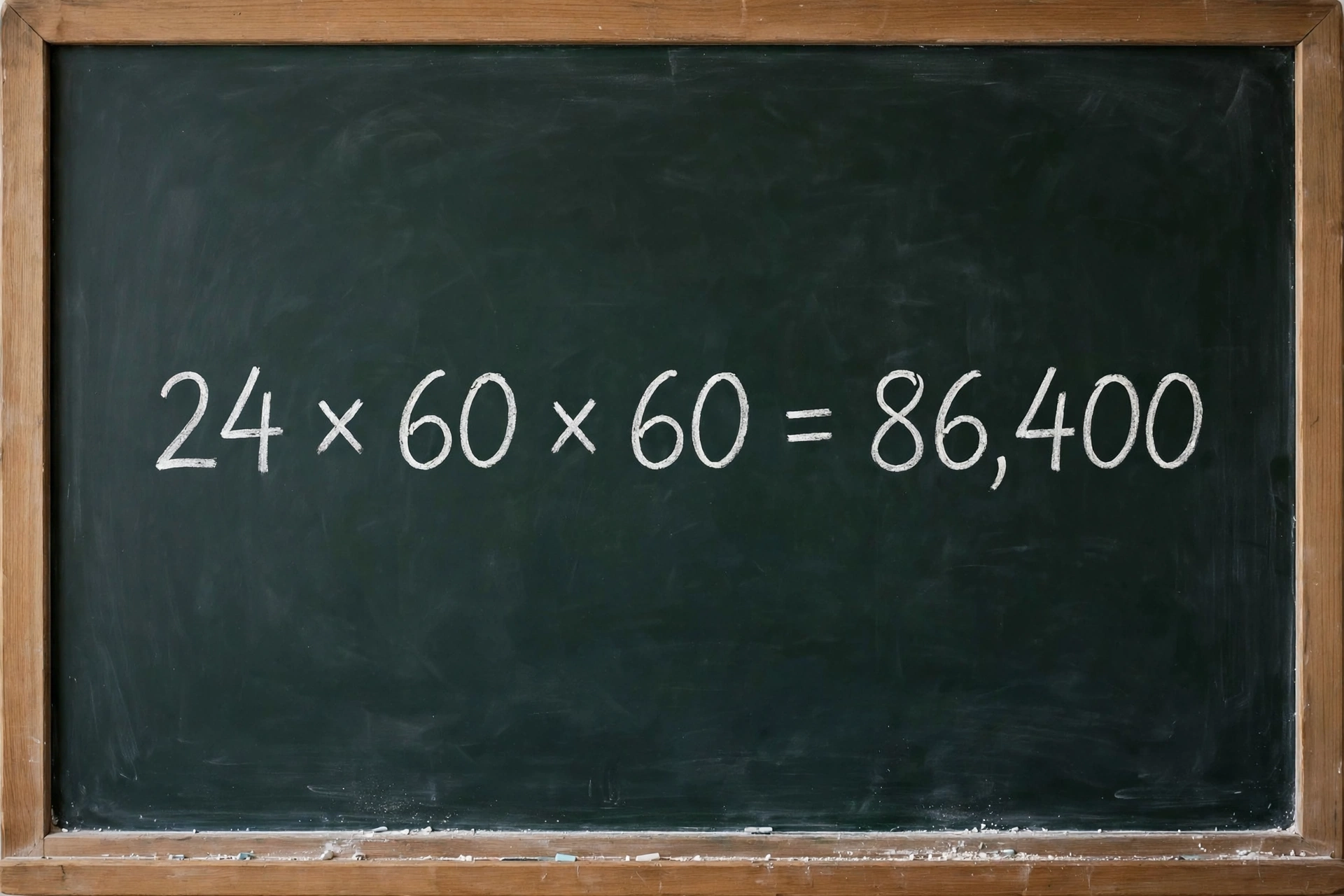
The math is just three numbers multiplied together: 24 hours × 60 minutes × 60 seconds.
Why 24 Hours and 60 Minutes?
The 86,400 figure comes from two old choices that stuck. The 24-hour day goes back to the ancient Egyptians, who split daylight and darkness into 12 parts each. The 60-minute hour and 60-second minute come from the Babylonians, who counted in base 60 instead of base 10. We kept both systems because they work well: 60 divides neatly by 2, 3, 4, 5, 6, 10, 12, 15, 20, and 30, which makes splitting time into halves, quarters, and thirds clean.
What About Leap Seconds?
Once in a while, timekeepers add a leap second to keep clocks in line with Earth’s rotation, which is not perfectly steady. On one of those rare days, the day holds 86,401 seconds instead of 86,400. It last happened in 2016, and the plan is to phase leap seconds out by 2035. For everyday math, homework, and trivia, 86,400 is the number to use.
Seconds in a Week, Month, and Year
Once you know a day holds 86,400 seconds, the bigger units fall out fast:
- 1 minute: 60 seconds
- 1 hour: 3,600 seconds
- 1 week: 604,800 seconds (86,400 × 7)
- 1 month: it depends. A 30-day month has 2,592,000 seconds. A 31-day month has 2,678,400. February has 2,419,200 in a common year and 2,505,600 in a leap year.
- 1 year: 31,536,000 seconds in a common year (365 days), and 31,622,400 in a leap year (366 days).
If you ever need a quick estimate, round a month to 2.6 million seconds and a year to 31.5 million. Close enough for planning, and you can tighten it up with the exact figures above when it matters.
What 86,400 Seconds Actually Feels Like
Big numbers go numb fast, so here is what a day’s worth of seconds looks like in body terms. Your heart beats somewhere around 100,000 times a day, which works out to a little more than one beat per second on average. You take roughly 20,000 breaths. You blink somewhere between 15,000 and 20,000 times. So while the clock ticks 86,400 times, your body is quietly running its own count alongside it.
It also puts small habits in perspective. A 30-minute walk uses 1,800 seconds, about 2% of your day. Eight hours of sleep takes 28,800 seconds, a full third. Scrolling for an hour costs 3,600 seconds you will never get back — which is fine, as long as you meant to spend them.
A Handy Way to Use the Number
People usually look this up for a reason: a math problem, a quiz, a piece of code, or a bet with a friend. If it is code, 86400 is the constant you want — it shows up everywhere from countdown timers to scheduling. If it is a school problem, show the two-step version (1,440 minutes, then × 60) so the teacher can see your working. And if it is a trivia question, the follow-up is usually “how many seconds in a week?” — now you know that one too: 604,800.
If you like this kind of conversion, the same style of breakdown works for distance. A mile holds 5,280 feet — see how many feet are in a mile for the full walk-through — and if you track your walks, you might also want to know how many steps are in a mile, which lands around 2,000 for most adults.
Frequently Asked Questions
How many seconds are in a day?
Exactly 86,400 seconds. That comes from 24 hours × 60 minutes × 60 seconds.
How many seconds are in 24 hours?
Same number: 86,400 seconds. A 24-hour period and a day are the same length here.
How many seconds are in a week?
There are 604,800 seconds in a week. Multiply one day’s 86,400 seconds by 7 days.
How many seconds are in a year?
A common year (365 days) has 31,536,000 seconds. A leap year (366 days) has 31,622,400 seconds.




One thought on “How Many Seconds Are in a Day? The Exact Number”