






You are standing in the kitchen, recipe open, and it calls for a quart of stock. The carton in your fridge says 32 fluid ounces. Your measuring cup says cups. And now you are doing math with wet hands. Here is the answer, plain and simple: 1 US quart = 4 US cups. That is […]
You are standing in the kitchen, recipe open, and it calls for a quart of stock. The carton in your fridge says 32 fluid ounces. Your measuring cup says cups. And now you are doing math with wet hands.
Here is the answer, plain and simple:
1 US quart = 4 US cups.
That is it. Keep reading for the quick math, the US versus UK difference that causes most mix-ups, and everyday examples so you never have to stop mid-recipe to search again.
The Short Answer
In the US customary system, the one used on American recipes, cartons, and measuring cups:
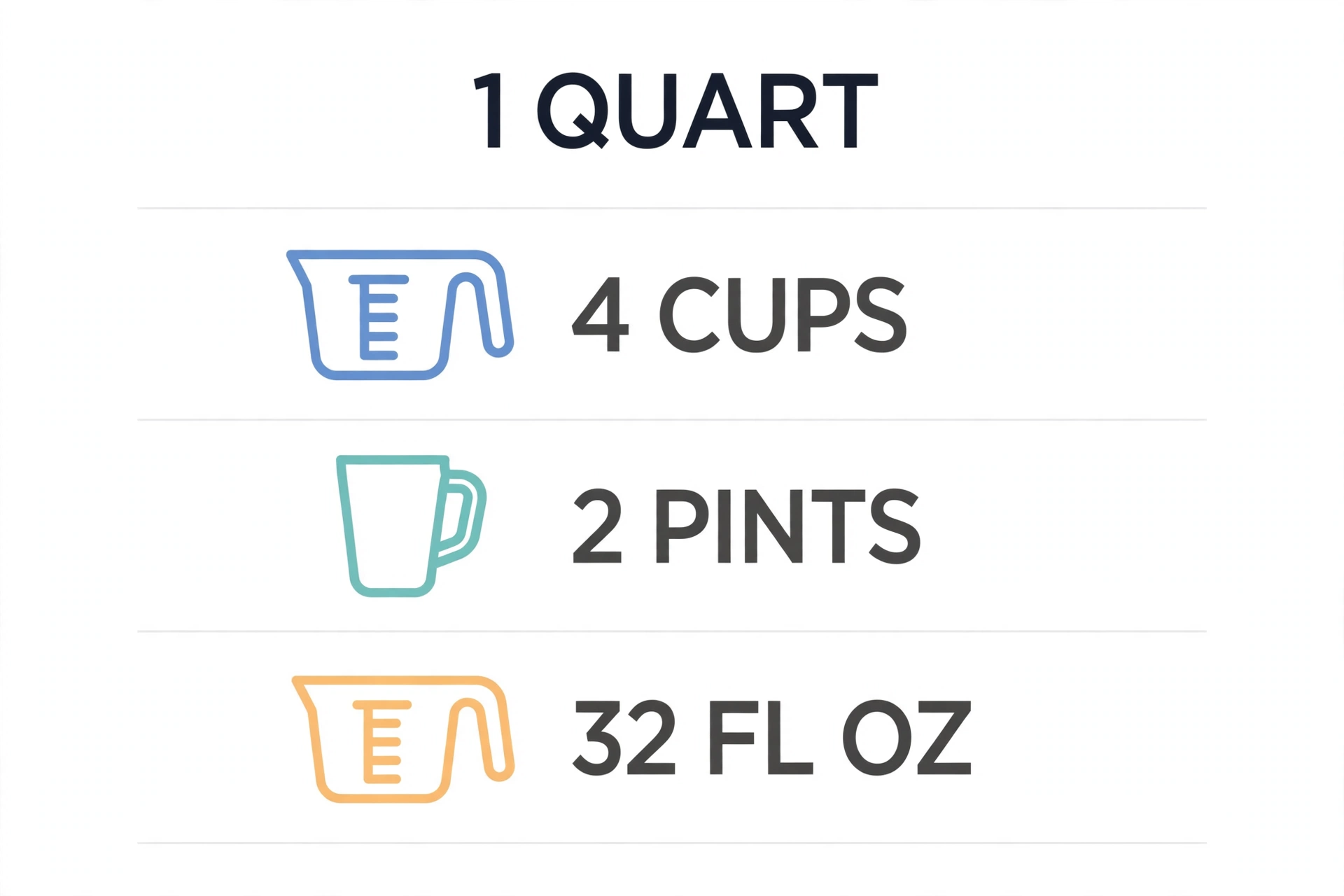
- 1 US quart = 4 US cups
- 1 US quart = 2 pints
- 1 US quart = 32 fluid ounces
- 1 US quart = 4 cups = 2 pints = 32 fluid ounces
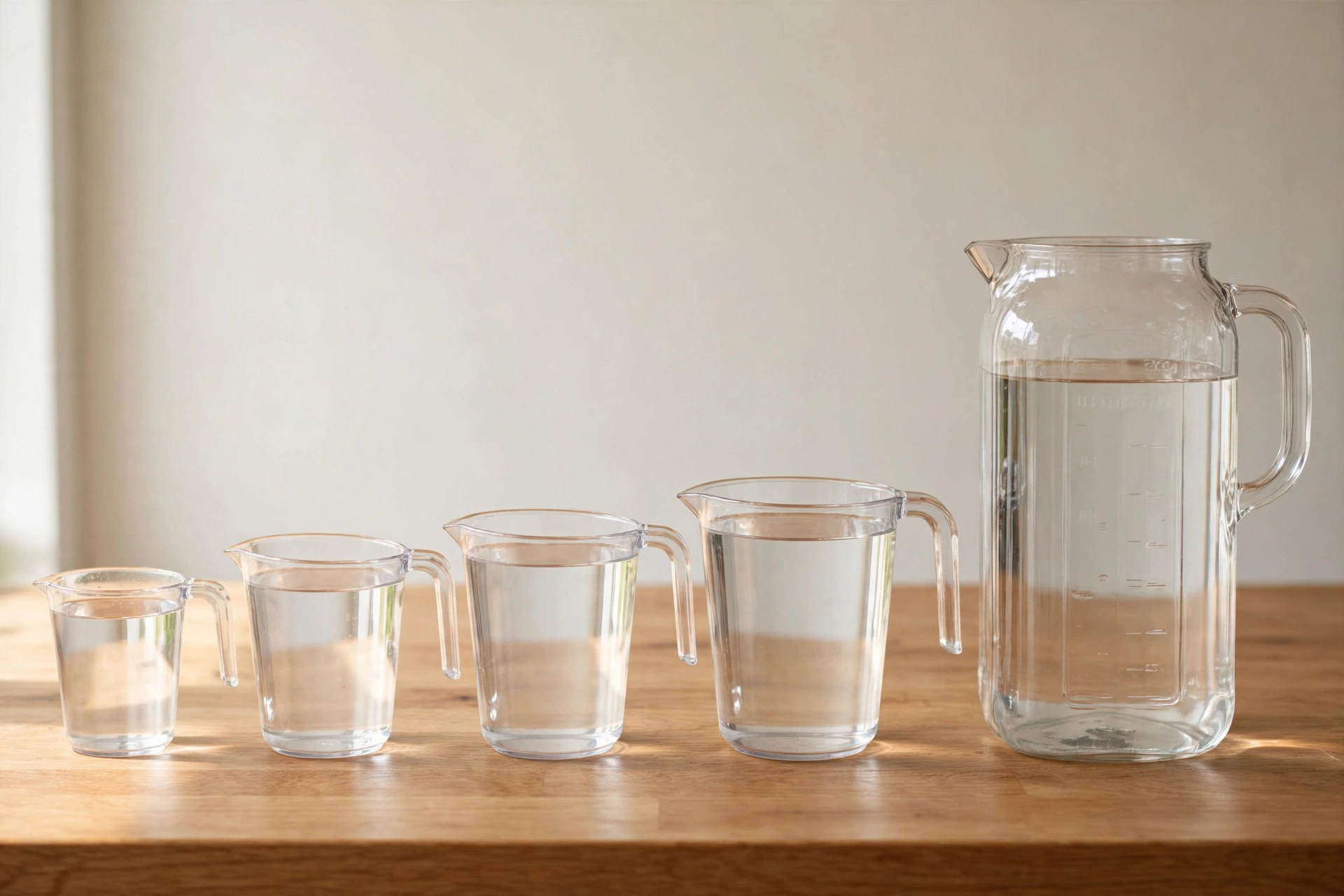
Think of a quart as a group of four cups. Pour four cups into a big measuring jug and you have filled one quart. Pour two pints in and you get the same result, because each pint holds two cups.
A gallon holds four quarts, so it holds sixteen cups. For the full picture, this guide on how many quarts are in a gallon lays out the whole chain from cups to gallons.
Why This One Trips People Up: US Quart vs. UK Quart
Most confusion around quarts comes from one thing: the US quart and the UK imperial quart are not the same size.
This article talks about the US quart, the one on American milk cartons, broth cartons, and measuring cups. A US quart is about 946 milliliters.
The UK imperial quart is bigger — about 1,136 milliliters, roughly 4.8 US cups. That difference matters if you are following a British recipe. A UK pint is also bigger than a US pint, so the whole set of measurements shifts.
How do you know which one a recipe means? Look for clues:
- If the recipe uses Fahrenheit, cups, tablespoons, and ounces the American way, it means a US quart.
- If it uses Celsius, grams, and millilitres, and it comes from a UK site or cookbook, it may mean an imperial quart.
- If the carton in your store says “1 QT” and lists 32 fluid ounces, that is a US quart.
For everyday cooking in the US, you can safely assume US quarts. And when a recipe just says “quart” with no other hint, and you are cooking in the US, go with 4 cups.
The Quart-to-Cup Conversion Table
Sometimes a table is faster than a paragraph.
| Quarts | Cups | Pints | Fluid Ounces |
|---|---|---|---|
| 1/4 quart | 1 cup | 1/2 pint | 8 fl oz |
| 1/2 quart | 2 cups | 1 pint | 16 fl oz |
| 3/4 quart | 3 cups | 1 1/2 pints | 24 fl oz |
| 1 quart | 4 cups | 2 pints | 32 fl oz |
| 1 1/2 quarts | 6 cups | 3 pints | 48 fl oz |
| 2 quarts | 8 cups | 4 pints | 64 fl oz |
| 3 quarts | 12 cups | 6 pints | 96 fl oz |
| 4 quarts | 16 cups | 8 pints | 128 fl oz |
Notice the pattern. Every quart adds four cups. Half a quart is two cups. Two quarts is eight cups. Once you see that rhythm, you can do most conversions in your head without reaching for your phone.
How to Convert Cups to Quarts
Recipes do not always ask the question in the same direction. Sometimes you need cups in a quart; other times you have cups and need quarts. Both use the same simple idea.
Cups to quarts: divide by 4
To turn cups into quarts, divide the number of cups by 4.
Quarts = cups ÷ 4
A few examples:
- 4 cups ÷ 4 = 1 quart
- 8 cups ÷ 4 = 2 quarts
- 12 cups ÷ 4 = 3 quarts
- 6 cups ÷ 4 = 1.5 quarts
- 2 cups ÷ 4 = 0.5 quarts, or half a quart
Say you measured out 10 cups of chicken stock. Ten divided by four is 2.5, so you have two and a half quarts.
Quarts to cups: multiply by 4
To turn quarts into cups, multiply the number of quarts by 4.
Cups = quarts × 4
A few examples:
- 1 quart × 4 = 4 cups
- 2 quarts × 4 = 8 cups
- 1.5 quarts × 4 = 6 cups
- 0.5 quarts × 4 = 2 cups
- 0.25 quarts × 4 = 1 cup
Say a soup recipe calls for 1.5 quarts of broth. Multiply 1.5 by 4 and you get 6 cups.
Cups and quarts measure volume — how much space something takes up. Ounces on a kitchen scale measure weight. This guide on how many ounces are in a pound covers the weight side, so you do not mix the two up.
Real Kitchen Examples
Here are the spots where quarts and cups show up most often.
Soup and stock
This is the big one. Broth and stock are sold by the quart in most US stores — that familiar carton that says 32 fluid ounces. A soup recipe that calls for 2 quarts of stock needs 8 cups. One carton gives you 4 cups, so you are one carton short. If the recipe calls for 6 cups and you have a quart carton, you need 2 more cups from somewhere else.
Stock is also where doubling gets tricky. Say your soup uses 1 quart of stock and serves four people. Double it for eight and you need 2 quarts, which is 8 cups — two full cartons. Buy both before you start.
Doubling and halving recipes
Doubling is multiplying by two. Halving is dividing by two.
- A recipe calls for 1 quart of milk. Double it: 2 quarts, or 8 cups.
- A recipe calls for 2 quarts of water for pasta. Halve it: 1 quart, or 4 cups.
- A recipe calls for 3 cups of cream. Double it: 6 cups, which is 1.5 quarts.
- A recipe calls for 8 cups of broth. Halve it: 4 cups, which is 1 quart.
When a doubled amount lands on 6 cups, just measure six scoops with a 1-cup measure. No quart jug needed.
When the carton and the recipe disagree
Recipes and cartons do not always use the same unit. Your recipe might say “1 quart of buttermilk” while the store sells it in pint cartons and half-gallon jugs:
- A pint is 2 cups, so you need two pint cartons to make a quart.
- A half-gallon is 2 quarts, so half a half-gallon jug is 1 quart, or 4 cups.
- A gallon is 4 quarts. If you need 1 quart from a gallon jug, pour out 4 cups and you still have 12 cups left.
For the gallon side of the same family, see how many ounces are in a gallon.
Baking and smaller amounts
Baking uses quarts less often than soups do, but a big batch of pancake batter, a bread pudding for a crowd, or a pitcher of lemonade might call for quarts. Same math: multiply quarts by four to get cups, or divide cups by four to get quarts.
For smaller amounts, cups break down into tablespoons and teaspoons — see how many teaspoons are in a tablespoon.
How to Measure a Quart Without a Quart Jug
You do not need a special quart container. A regular 1-cup measuring cup works fine — it just takes four pours.
For liquids like water, milk, and broth:
- Set your measuring cup on a flat surface. Do not hold it in the air.
- Pour until the liquid reaches the 1-cup line.
- Bend down so your eyes are level with the line. Looking from above makes it easy to over-pour.
- Pour the cup into a pot or bowl. Repeat three more times for a full quart.
For dry ingredients like flour or sugar, spoon the ingredient into the cup until heaped, then sweep a knife across the top to level it. Do not pack flour down unless the recipe tells you to — packed flour measures heavier and can make baked goods dense.
Liquid and dry measuring cups are not the same tool. Liquid cups have a spout and room above the top line so you can carry them without spilling. Dry cups are filled to the brim and leveled. For a quart of liquid, a jug with quart markings is easiest. For a quart of flour, use the dry cup four times.
A Quick Way to Remember It
Keep one image in mind: a quart is a little family of four cups. Two cups make a pint, and two pints make the quart. Four cups, two pints, one quart, 32 ounces. That is the whole set.
Or remember the chain:
1 gallon = 4 quarts = 8 pints = 16 cups = 128 fluid ounces
Every step is a multiply or divide by two or four.
FAQ
How many cups are in 1 quart?
4 cups. In the US customary system, 1 US quart equals 4 US cups, 2 pints, and 32 fluid ounces.
How many cups are in 2 quarts?
8 cups. Multiply quarts by 4: 2 × 4 = 8.
How many quarts is 8 cups?
2 quarts. Divide cups by 4: 8 ÷ 4 = 2.
Is a US quart the same as a UK quart?
No. A US quart is about 946 milliliters and holds 4 US cups. A UK imperial quart is about 1,136 milliliters and holds roughly 4.8 US cups. If you are cooking from a US recipe, use the US quart.
How many cups are in a quart of milk?
4 cups. A quart carton of milk holds the same volume as any other US quart — 4 cups, or 32 fluid ounces. The same goes for a quart of water, broth, or cream.




One thought on “How Many Cups in a Quart?”